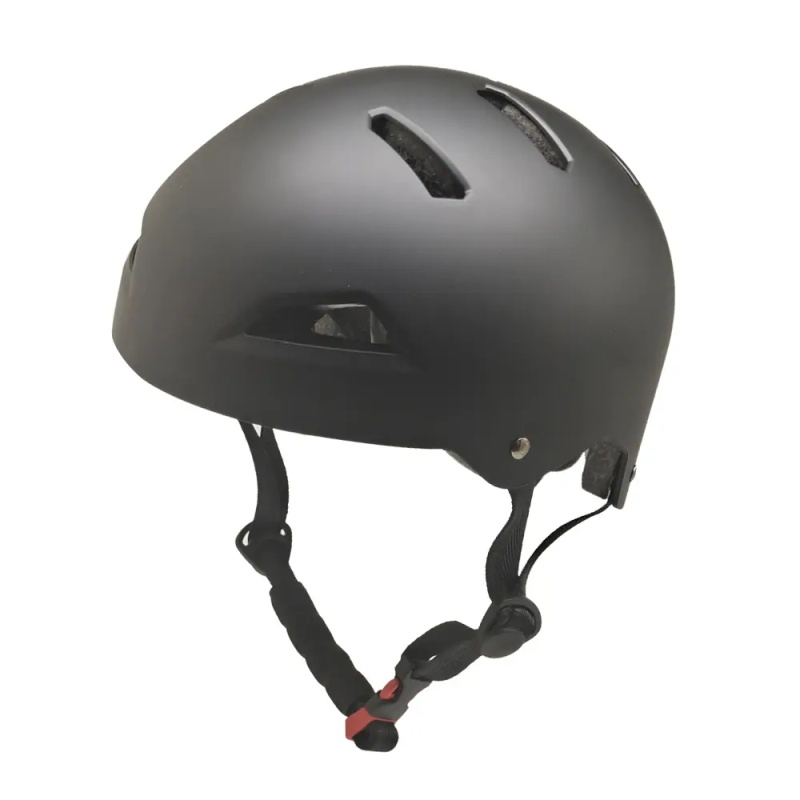
The reason for wearing a cycling helmet is simple and important - to protect your head and reduce injuries. Relevant data show that in more than 500 bicycle fatalities every year, 75% of the deaths are caused by fatal head injuries. Medical research has found that wearing a helmet on a bicycle can prevent 85% of head injuries, and greatly reduce the degree of injury and accident mortality. Half-helmet riding helmets are divided into road-specific (without brim), road and mountain dual-use (with detachable brim), etc.
Cycling helmets work on the principle of protection by absorbing the impact of a crash. In other words, every cycling helmet has a foam inner layer that, in the event of an accident, cushions the impact to reduce accident damage. Traditionally, many cycling helmets have been made from EPS (expanded polystyrene) materials. Once the EPS foam is crushed and deformed in an accident, it cannot be recovered and used again. In addition, there are helmets with inner layers made of EPP (expanded polypropylene) foam. Although EPP foam can be used again after being hit, its impact absorption strength is far less than that of EPS foam. So, after years of research and improvement. A new multi-protective foam Tau Re Up combining EPS and EPU (polyurethane) was born. Not only that, many cycling helmets use carbon fiber to reduce the weight of the helmet.
Cycling helmet classification:
Half-helmet riding helmets are divided into road-specific (without brim), road and mountain dual-use (with detachable brim), etc. Use helmets similar to those used for baseball or roller skating. Full-face riding helmets are similar in shape to motorcycle helmets and are generally used by downhill or climbing bike enthusiasts.
Cycling helmets generally consist of 7 parts:
Hat Shell: The hard shell that is the outer layer of the helmet. In the event of an accidental collision, the cap shell is the first line of defense to protect the head and is used to disperse the impact force.
Cap Body: The foam inner layer inside the helmet. It is the second line of defense to protect the head. It is mainly used to absorb the impact force in the accident and reduce the accident injury.
Buckle and chinstrap (safety harness): Used to secure the helmet in place. The straps are fixed under the ears on both sides, and the buckles are fixed at the throat. Note: After the buckle is fastened, there should be 1 to 2 fingers of space between the buckle and the throat. Remember not to be too tight or too loose.
Brim: The brim is divided into two types: fixed and adjustable. General road cycling helmets do not have a brim. The function of the brim is to prevent foreign objects from flying into the eyes of the rider, and at the same time, it has a certain shading effect.
Air holes: The air holes are to help the head dissipate heat and ventilate, which can keep the hair dry during long rides. The more air holes, the cooler the rider will feel, but the lower the relative safety factor. Generally, it is better to choose a helmet with the right amount of air holes.
Knobs: There are knobs on the back of the riding helmet for adjusting the tightness. Riders can adjust the helmet size according to their head size.
Padding: The padding absorbs sweat and microscopic vibrations from the body during cycling.
The above is the information about helmets. If you want to know more news and product news, you can click our official website. We also sell Bike Helmet, Snow Goggles, Ski Helmet, Ski Back Protector, Skate Helmet, Skate Protective Pads, welcome Major customers come to consult.